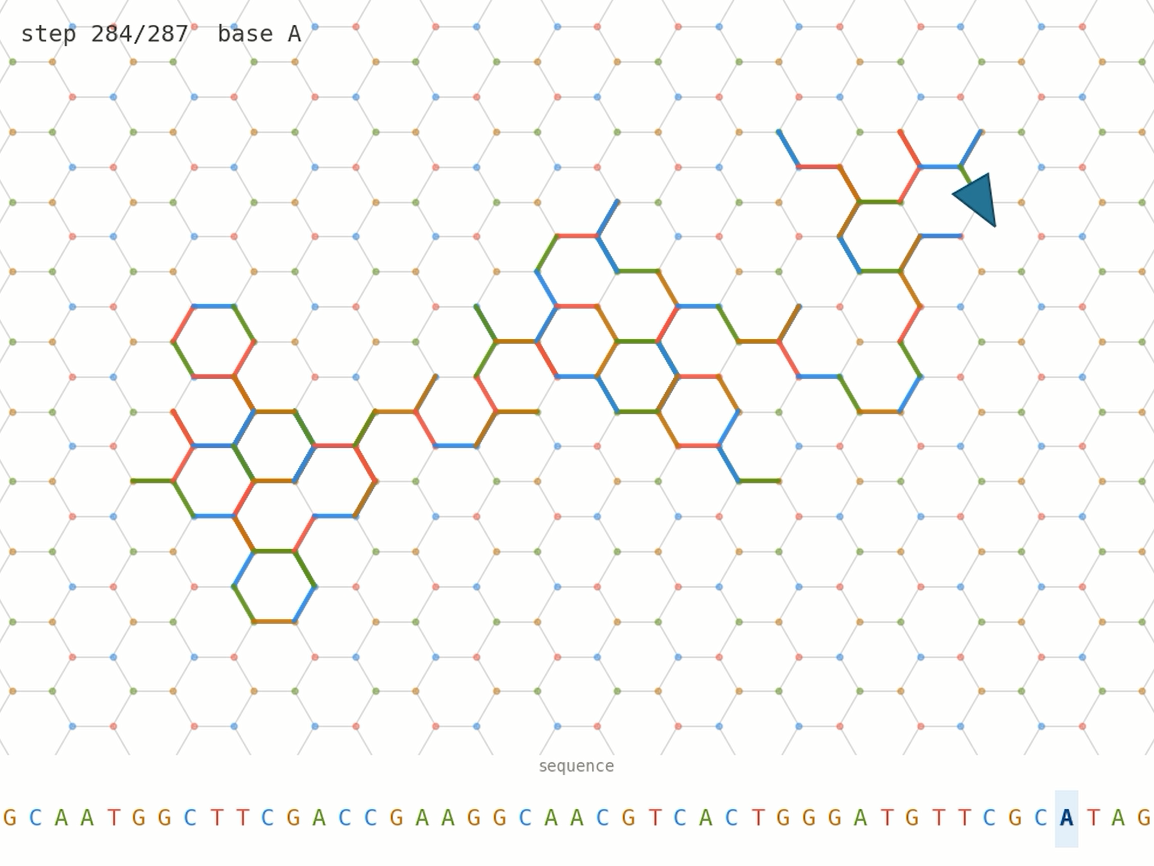
GeneGebra, a startup backed by LAB+, has unveiled HexaPlot, a tool that transforms genomic sequences into unique geometric signatures, offering a new way to visualize and analyze the information encoded in DNA.
Genomic sequencing determines the precise order of the four “letters” that make up DNA (A, T, C, and G). This information is essential for understanding which genes an organism carries, how they function, and how individuals or species differ from one another. It has a wide range of applications, including disease diagnosis, personalized medicine, and the identification of viruses, bacteria, and fungi.
HexaPlot uses a mathematical model developed by GeneGebra, called Genocube, to convert each DNA sequence into a unique visual representation. As it reads the sequence of the four DNA bases, it maps the path onto a hexagonal grid, generating a distinctive geometric pattern—a kind of visual fingerprint that uniquely identifies each genetic sequence.
This technology opens up new possibilities for genomic research, including:
- Building microbial biobanks through compact representations of complex genomic landscapes.
- Classifying genetic variants based on their geometric signatures.
- Identifying genetic determinants of antibiotic resistance and antiretroviral therapy (ART) resistance.
- Exploring, comparing, and classifying genomic diversity using artificial intelligence in an intuitive, scalable, and computationally efficient way.
“We believe the future of genomics is not just about reading more DNA, but about representing it in a fundamentally different way,” said Xavier Berthet, co-founder of GeneGebra.
Researchers and research institutions interested in testing HexaPlot can request a demonstration by contacting info@genegebra.com.